
Office Kitchen Food Safety Employer Responsibilities in Ireland
What You Really Need to Know
Office Kitchen Food Safety Responsibilities for Employers
Office kitchen food safety is often overlooked in workplaces, yet employers in Ireland have a legal duty to protect staff from foodborne illness. Shared fridges, poor hygiene practices, and lack of food safety training can expose employers to claims when staff get sick.
Poor office fridge hygiene is a common cause of food poisoning in shared workplace kitchens.
Scene: 250-employee tech company, Dublin IFSC. Open-plan office. Free coffee. And a communal fridge.
Week 1: Sarah from Accounts leaves strawberry yoghurt (expires “Best Before 12 Nov”).
Week 3: Sarah’s on holiday. Yoghurt sits forgotten.
Week 4 (Dec 5): Mark, a new hire, finds it. Reads date as “Dec 12” (thinks it’s safe). Eats it.
48 hours later: Mark hospitalized with Salmonella. Misses 2 weeks. Files personal injury claim.
Employer’s defense: “We provide the fridge as a courtesy. Employees manage their own food.”
Court’s finding: Under Safety, Health & Welfare at Work Act 2005 (Section 8), employers have a duty to provide a safe workplace, including welfare facilities. Allowing the break room fridge to become a biological hazard (mold, expired food, cross-contamination) breaches that duty.
Result:
- €28,000 settlement (medical + lost wages + distress)
- €12,000 legal fees
- €5,000 safety consultant fees
- Total: €45,000
The trap: Employers think “office kitchens aren’t our problem.” But under Irish law, if you provide a facility, you’re responsible for maintaining it safely including that yoghurt.
The Legal Reality Who IS Responsible?
Typical corporate setup:
- 200 employees, 5 floors
- Shared break rooms (microwave, kettle, fridge, sink)
- No canteen (staff bring lunches)
- Cleaning staff clean counters/floors but NOT fridge interiors
- No policy on cleanouts or expired food
When someone gets sick:
| Party | Argument | Legal Reality |
|---|---|---|
| Employer | “Employees bring own food it’s their responsibility” | ❌ Liable under Section 8, Safety Act 2005: Duty to maintain welfare facilities |
| Facility Manager | “We clean surfaces, not fridge interiors outside our contract” | ⚠️ Partially liable if contract specifies fridge cleaning, but primary duty on employer |
| Catering Company | “We don’t manage staff fridges only deliver meeting lunches” | ✅ Not liable (no control over personal food) |
| Employee (victim) | “I didn’t know yoghurt was expired misread date” | ⚠️ Contributory negligence possible (reduces claim), but doesn’t remove employer duty |

- Bottom line: The employer is primarily liable because they:
- Provide the facility
- Control access
- Have a legal duty to maintain a safe workplace
Sources: Health & Safety Authority | Safety, Health & Welfare at Work Act 2005
Office Fridge Hygiene: Common Risks in Shared Kitchens
Office fridge hygiene failures often include unlabeled food, expired leftovers, raw and ready-to-eat foods stored together, and fridges operating outside safe temperature ranges.
Improving office fridge hygiene reduces the risk of foodborne illness in shared kitchens and helps employers demonstrate due diligence during workplace investigations.
Regular checks, cleaning schedules, and clear ownership rules are essential to maintaining proper office fridge hygiene in shared staff kitchens.
Three Hidden Hazards in Every Office Break Room
Hazard #1: The Fridge Forgotten Lunch Petri Dish
The problem:
- No expiry date monitoring
- No regular cleanouts (food sits weeks/months)
- Cross-contamination: Raw chicken juice leaks onto salads
The microbiology:
- Fridge set at 5°C (correct), but door seals fail → temp rises to 8–10°C
- Listeria monocytogenes thrives at 4–8°C (multiplies even in fridges)
- Salmonella survives on surfaces for 4 days
- Mold spores spread from expired to fresh food
Real incident (Dublin 2024):
Law firm’s fridge cleaned after 18 months. Contents:
- 14 expired yoghurts (oldest: 11 months past date)
- 3 tupperware containers with green mold
- 1 leaking chicken package (next to fruit salads)
No illness (by luck), but HSA inspector cited them for inadequate facilities during audit.

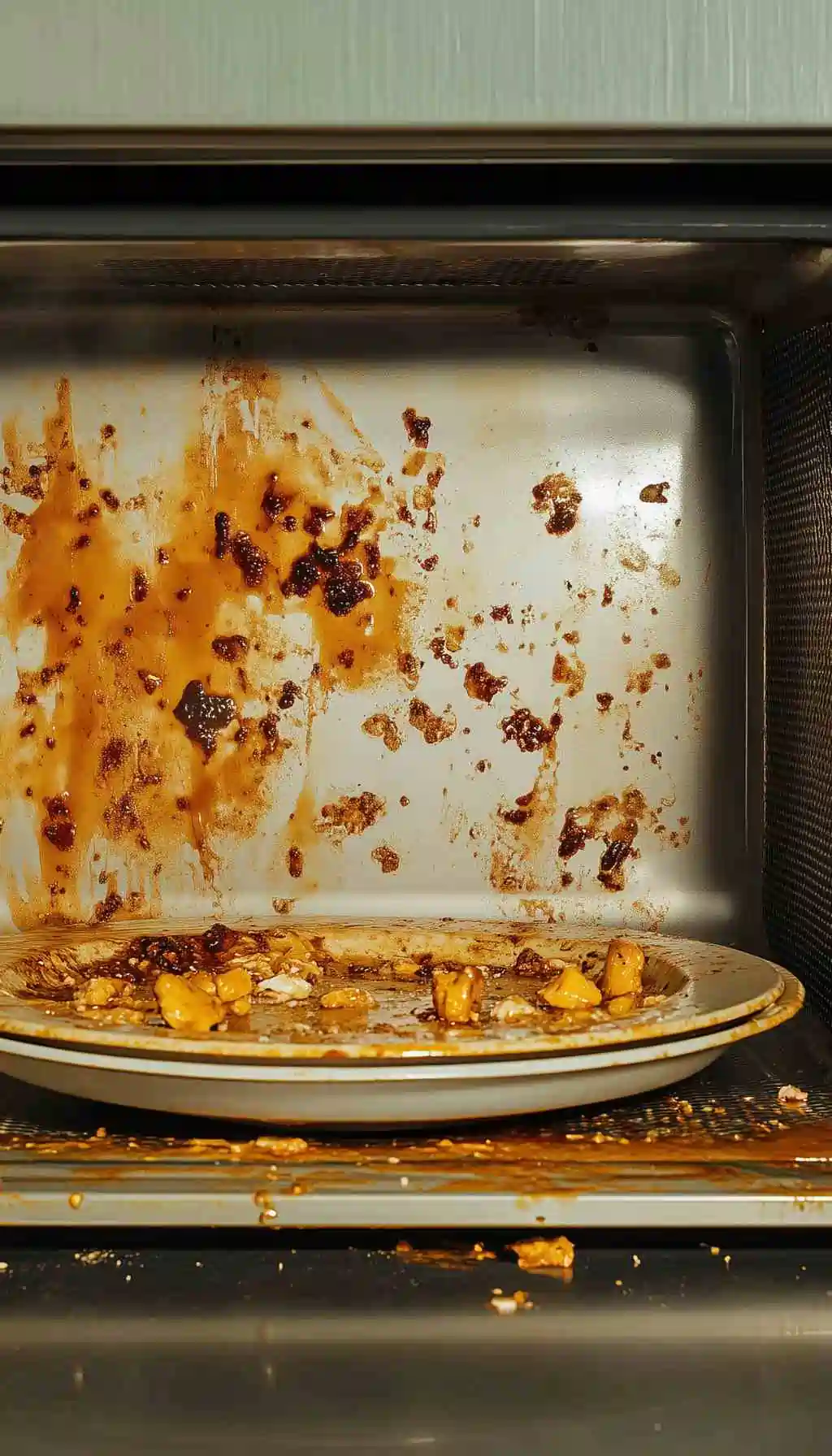
Hazard #2: The Microwave Splatter Contamination
The problem:
- Staff reheat food (soup, curry, pasta)
- Splatter collects inside (tomato sauce, chicken grease)
- Not cleaned between uses
- Bacteria multiply in warm, moist residue
The science:
- E. coli and Staphylococcus aureus survive in dried splatter
- Next user’s food gets contaminated by droplets
Typical scenario:
- Monday: John reheats chicken curry (splatter inside)
- Tuesday: No cleaning
- Wednesday: Emma reheats vegetarian pasta → chicken bacteria land on her food
- Thursday: Emma sick (gastroenteritis)
Liability: The employer (provided microwave, failed to ensure cleaning).
Hazard #3: The Sink – No Soap = No Handwashing
-
The problem:
- Soap dispenser empty for days/weeks
- No handwashing signage
- Staff assume “it’s an office, not a restaurant”
The reality:
- 70% of office keyboards carry more bacteria than toilet seats (University of Arizona, 2022)
- No handwashing before eating = direct bacterial transfer
Legal obligation: Under Safety, Health & Welfare at Work (General Application) Regulations 2007, employers must provide washing facilities with soap and towels.
Source: S.I. No. 299/2007 – Workplace Facilities Regulations
The Liability Cascade Christmas Party Leftovers
Dec 18: Office party. Catering delivers prawns, chicken satay, quiches.
Dec 19: Leftovers stored in break room fridge (no temp monitoring, no labels).
Dec 20: Staff eat leftovers.

Dec 21: 5 employees call in sick (food poisoning).
The claims:
|
Who |
Claim |
Liability |
|---|---|---|
|
5 Employees |
Personal injury |
⚖️ Employer (unsafe facility) |
|
Employer |
Sue catering (“Your food made staff sick”) |
❌ Fails (catering delivered safe food; employer stored it unsafely) |
|
Employer |
Sue facility manager (“You didn’t monitor fridge”) |
⚠️ Partial if contract specifies maintenance |
|
HSA |
Issue Improvement Notice |
✅ Employer (fix within 30 days or €3,000+ fine) |
Total cost:
- 5 settlements: €15,000–€40,000
- Legal fees: €10,000+
- HSA compliance: €5,000
- Total: €30,000–€55,000+

Financial Reality Break Room Costs
50-Person Office, 1 Break Room
Annual “hidden” costs (unmanaged):
|
Risk |
Probability |
Cost/Incident |
Expected Annual Cost |
|---|---|---|---|
|
Food poisoning claim (1 employee) |
3–5% |
€15,000–€28,000 |
€450–€1,400 |
|
Minor gastro (sick days, no claim) |
15–20% |
€500 (2 days × 3 staff) |
€75–€100 |
|
HSA Improvement Notice |
5–8% |
€5,000 |
€250–€400 |
|
Staff turnover (morale impact) |
5% |
€2,000 |
€100 |
|
Total expected cost |
— |
— |
€875–€1,900/year |
Prevention costs:
|
Intervention |
One-Time |
Annual |
|---|---|---|
|
Break room policy (HR drafts) |
€500 |
€0 |
|
Weekly fridge cleanout (15 min/week) |
€0 |
€780 |
|
Soap/sanitizer dispensers + refills |
€120 |
€240 |
|
Signage (handwashing, expiry checks) |
€80 |
€0 |
|
Acornstar Office Safety module (50 staff) |
€1,800 (€36/person) |
€360 (10 new hires) |
|
Total Year 1 |
€2,500 |
€1,380 |
ROI:
- Risk (do nothing): €875–€1,900/year average, but one major incident = €45,000
- Prevention: €3,880 Year 1
- Savings if you avoid ONE incident: €45,000 − €3,880 = €41,120
- Payback: Immediate (risk is 3–5%/year)

Case Study Dublin Financial Firm’s €28,000 Settlement
Background: 180-employee financial advisory, Dublin Docklands.
March 2024: Junior analyst eats colleague’s “chicken & mayo” sandwich from fridge (colleague on sick leave 2 weeks). Sandwich sat 14 days.
48 hours later: Hospitalized with Salmonella (4 days, severe dehydration).
Employer’s defense: “Employees are adults—they check their own food.”
Legal finding (WRC, July 2024):
- Breached Section 8(2)(b) Safety Act: “Duty to manage activities to prevent risk.”
- Communal fridge creates a risk → employer must manage it
- No policy = failure to manage = negligence
Settlement:
- €28,000 to employee
- Required to: 1) Weekly fridge cleanout, 2) “Use By” labels, 3) Staff training
Post-settlement costs:
- Training (180 × €36): €6,480
- Consultant: €1,200
- Total Year 1: €28,000 + €7,680 = €35,680
Lesson: €2,500 prevention would have saved €33,180.
The Solution: 4 Essential Policies
Policy #1: Weekly Fridge Cleanout (“Friday Purge”)
What: Every Friday 4 PM, facility manager clears:
- Items past expiry
- Unlabeled items older than 5 days
- Wipe shelves with antibacterial cleaner
Enforcement:
- Thursday 3 PM email: “Fridge cleanout tomorrow label or lose it!”
- Color labels: Green = This week, Yellow = Next week, Red = Expired
Cost: €15/week (15 min) = €780/year
Policy #2: Mandatory “Use By” Labels
What: All fridge food MUST have label with:
- Owner’s name
- Date stored (“Stored: 12 Dec 2025”)
- Unlabeled food discarded after 24 hours
How: Label dispenser + marker next to fridge. Signage: “No Label = No Storage”Cost: €50 (dispenser + 12 months labels)

Policy #3: Monthly Fridge Temp Check
What: Facility manager checks temp 1st of month (should be ≤5°C). If above → service within 48 hours.
Why: 8–10°C = bacteria multiply rapidly. Door seals degrade over time.
How: Fridge thermometer (€20) + monthly log.Cost: €20 one-time

Policy #4: Break Room Hygiene Training (Acornstar)
What: All staff complete 30-minute Office Safety module during onboarding. Covers:
- Handwashing before eating
- How to label/store food safely
- Cross-contamination risks
- When to discard expired food
Why: Employees don’t know they’re creating hazards—training changes behavior.
Acornstar Office Safety Module:
- Visual scenarios (drag-and-drop fridge storage)
- Quiz (identify expired food)
- Certificate (HR files, meets Section 8 training duty)
Cost: €36/person (€1,800 for 50 staff + €360/year for 10 new hires)
Acornstar Angle: “We build bespoke ‘Office Safety’ modules that cover more than fire exits we cover kitchen hygiene for general staff too.”
Action Plan: 4 Weeks to Compliance
|
Week |
Task |
Cost |
Outcome |
|---|---|---|---|
|
1 |
Audit: Fridge temp, soap, expired food count |
€0 |
Baseline assessment |
|
2 |
Draft policies: Cleanout, labels, temp checks |
€500 (HR, 3 hours) |
Written policies |
|
3 |
Enroll staff in Acornstar Office Safety |
€36/person |
Certificates |
|
4 |
Implement: Dispensers, signage, schedule |
€250 |
Compliant break room |
Total: €750 + (€36 × staff count)
For 50 staff: €750 + €1,800 = €2,550
Result:
- Zero liability gaps
- Avoid €45,000 claim (pays for 17 years of prevention)
- Staff morale boost
Empower Your Team with Accredited Training
Investing in your staff’s development is the best way to ensure safety and quality in your business. Whether you are onboarding new recruits or upskilling your management team, our online courses provide flexible, industry-recognized certification.
For your kitchen brigade, we offer a clear progression path: start with Food Safety HACCP Level 1 for beginners, move to HACCP Level 2 for standard food handlers, and advance to HACCP Level 3 for your supervisors and managers.
Don’t miss out: We are currently including Allergen Awareness training for free with selected food safety courses. You can also purchase the Allergen Awareness Course separately or as part of our comprehensive Level 1 & 2 Bundle.
Beyond the kitchen, ensure your entire premises is safe with our Fire Warden Online Training and our essential Slips, Trips & Falls course.
A Smarter Way to Manage Compliance For our business customers, we remove the administrative headache by providing a Free Learning Management System (LMS). This powerful tool allows you to track enrollments and progress through one smart, easy login. You will have instant access to copies of all certificates, ensuring you are always audit-ready. It is designed to save your team valuable time and offers fast savings compared to other learning platforms.
Contact us directly to discuss bundle pricing or view all courses here.
The Bottom Line
Employers think: “It’s just a fridge. Not our problem.”
The law says: Section 8, Safety Act 2005: You provide it → you maintain it safely → you train staff.
One claim costs: €15,000–€45,000+
Prevention costs: €2,550 (for 50 staff)
Your choice: Ignore the fridge and hope or invest 6% of one claim to eliminate risk.
Next Steps
👉 Train staff TODAY: Acornstar Office Safety (€36/person, 30 min, certificate)
👉 Bespoke module? Custom scenarios for your office (€1,200)
👉 Free checklist? Download “Office Kitchen Hazard Checklist” (PDF)
Contact: Acornstar Training | Email: info@acornstar.com
Final Thought: The break room fridge isn’t a “nice-to-have” it’s a legal liability. Clean it. Label it. Train staff. Or pay €45,000 when someone gets sick.