
Off-the-Shelf HACCP Systems Put Irish Food Businesses at Risk
Why a Downloaded HACCP Template Won't Stand Up to an EHO Inspection
What Inspectors Actually Look For
You’ve poured everything into your food business. Long hours. Real money. The menu you’ve fine-tuned. The premises you searched months for. The team you’ve trained up. The last thing on your mind on a busy Tuesday is an Environmental Health Officer showing up with a clipboard.
But here’s the uncomfortable truth. If your HACCP folder is a free template you downloaded online or a generic off-the-shelf HACCP system you bought in a hurry that visit could end with a closure notice in your window.
This article explains why generic HACCP plan templates are failing Irish food businesses, what the law actually requires, and how to move from paperwork compliance to real protection.
Are HACCP Plan Templates Legal in Ireland?
Plenty of operators search for a free HACCP plan template, a HACCP template Ireland businesses commonly use, or an off-the-shelf HACCP system in a folder. They look professional. They’re cheap or free. They tick what looks like a regulatory box.
But any HACCP consultant Ireland businesses trust will tell you the same thing. Generic templates rarely meet Irish legal requirements. They almost never reflect the real risks in a specific food operation. And inspectors can spot them in minutes.
The legal position is set out in Regulation (EC) No 852/2004. Every food business operator in Ireland must establish, implement, and maintain food safety procedures based on HACCP principles. The wording matters here. Your system must be based on your hazards, in your operation. Not someone else’s.
The Food Safety Authority of Ireland (FSAI) is clear on this point. Your HACCP plan must reflect the actual hazards present in your specific food business. That’s the whole point of HACCP identifying your unique risks and controlling them.
If your documentation describes a kitchen that isn’t yours, equipment you don’t own, and procedures you don’t follow, it isn’t just inadequate. It’s non-compliant.
The Enforcement Picture in Ireland
Let’s be honest about where things stand. The FSAI reported a sharp rise in enforcement action against Irish food businesses in 2024, with 133 enforcement orders served a roughly 45% increase on the previous year. Of those, 115 were closure orders. The reasons cited again and again? Inadequate documentation, weak staff training, and food safety systems that simply weren’t fit for purpose.
🚩 Flag for manual review: Verify the 2024 figures (133 enforcement orders, 45% increase, 115 closure orders) against the latest FSAI enforcement orders report before publishing.
EHOs have become very good at spotting generic systems. They’ve seen the same templates repeatedly. They know what’s been downloaded from the internet and bound into a folder without much thought. When they spot one, scrutiny ramps up across the whole inspection.
The message from the regulator is hard to miss. Cutting corners on food safety paperwork is a gamble most businesses can’t afford.
What Off-the-Shelf HACCP Systems Miss
The fundamental problem with generic HACCP plans is simple. They can’t see your kitchen.
Every food business is different. The equipment is different. The layout is different. The menu, the suppliers, the customers, the service style all different. A template designed to be broadly applicable ends up being specifically applicable to nobody.
Here’s what that looks like in practice.
Your Specific Equipment and Layout
Walk through your kitchen right now and take inventory. Do you have a commercial combi-oven or a standard convection oven? Is your refrigeration a single under-counter unit or a walk-in cold room? Do you have separate sinks for hand-washing, food preparation, and pot-washing, or are you working with limited facilities that require strict procedural controls?
Every piece of equipment you own, and where it’s positioned in your kitchen, affects your food safety risks. Cross-contamination hazards are dramatically different in a spacious kitchen with designated zones for raw and ready-to-eat foods compared to a compact space where careful workflow management is essential. Your HACCP plan must document how you’re using your actual equipment to control hazards something a generic template simply cannot do.
A HACCP consultant visiting your premises can identify risks specific to your layout: perhaps your hand-wash sink is positioned too far from the main preparation area, requiring additional controls. Maybe your cold storage is at capacity, necessitating more frequent deliveries and stricter stock rotation procedures. These aren’t details you’ll find in a downloadable template.
Your Menu and Ingredients
Two cafés can look almost identical from the street. One sells hot drinks, pre-packed sandwiches, and bought-in pastries. The other makes everything from scratch soups, sandwiches, cream-filled cakes prepared on-site.
Their food safety risks are completely different. Their HACCP plans should be too.
If you serve high-risk foods shellfish, rare-cooked meats, raw eggs, unpasteurised dairy, or sous-vide preparations you’ve got specific critical control points that need identifying, monitoring, and documenting. Ireland’s allergen rules add another layer. You must manage cross-contact with the 14 regulated allergens, and the controls have to match the allergens you actually handle.
A template might include a generic allergen warning. But does it reflect what’s really in your kitchen? Does it document how you keep your gluten-free options separate from your sourdough? Does it know you make your own sauces, when the template was written assuming you’d be using bought-in jars?


Your Service Style
How you serve food shapes your HACCP requirements as much as what you serve.
A fast-food outlet with minimal holding times has very different challenges to a carvery holding hot food across a long service. A nursing home preparing meals hours before consumption faces different risks again. So does a buffet, where temperature control over long display periods becomes the key concern. Catering operations need documented procedures for transporting food safely.
If you’re feeding vulnerable groups elderly residents, young children, immunocompromised patients your controls need to be tighter. These people are more susceptible to foodborne illness, and your plan has to recognise that.
A generic system can’t capture these differences. It was never built to.
Your Suppliers
Where your ingredients come from matters too. Are you buying from large national distributors with their own food safety programmes? Sourcing direct from small local producers? Importing speciality items? Foraging? Using produce from your own garden?
Each sourcing decision changes your risk profile. A bespoke HACCP plan documents your approved suppliers, your goods-in procedures, and how you verify that incoming ingredients are safe. None of that is generic it’s specific to the relationships you’ve built.
Red Flags, Is Your Current System Actually Protecting You?
Not sure if your HACCP folder is doing its job? Here are the warning signs.
The documentation doesn’t match your operation. If your plan mentions equipment you don’t have, dishes you don’t make, or procedures you don’t follow, it’s not fit for purpose. Even small mismatches matter they tell an inspector your system isn’t really yours.
You can’t explain your critical control points. Can you point to each CCP and explain what hazard it controls and why it matters? If you’ve got “CCP1, CCP2, CCP3” in a template without truly understanding them, you’ve got a problem.
Your team doesn’t use the system. If the folder lives in a drawer and nobody looks at it during service, that’s a red flag. A working HACCP system is part of daily operations because it actually reflects how the kitchen runs.
It hasn’t been reviewed in years. Your business has changed since you opened. New menu items. Replaced equipment. Layout tweaks. Different suppliers. If the plan doesn’t show those changes, it’s out of date and out-of-date documentation is non-compliant documentation.
You downloaded it for free. This is the clearest warning sign of all. The FSAI publishes guidance documents and sector frameworks, but a complete, ready-to-use HACCP plan isn’t something you download and slot in unchanged. If that’s what you’ve done, you’re almost certainly not compliant.
What Happens When an Inspector Spots a Generic System
Picture the moment. An EHO opens your folder, flicks through the first few pages, and recognises the template. What happens next?
Three things, roughly in this order.
First, your credibility takes a hit. You’ve signalled that food safety management hasn’t been taken seriously enough to develop something proper. The inspection becomes more rigorous from that point on.
Second, the questions get pointed. “Your plan refers to a blast chiller. I don’t see one. How are you actually cooling cooked food?” “This procedure assumes you’re using bought-in mayonnaise, but I can see you’re making your own. Where’s the controlled procedure for that?” If the answers don’t add up, enforcement gets closer.
Third, the inspector reaches for the toolkit. The FSAI’s enforcement framework includes improvement orders requiring you to fix issues by a deadline, prohibition orders preventing you from using specific equipment or processes, and closure orders shutting all or part of your business until serious risks are addressed.
In 2024’s surge of enforcement actions, inadequate documentation and insufficient training were cited time and again. Plenty of those businesses thought they were compliant. They had a HACCP folder. It just wasn’t the right one.
The Business Case for a Bespoke HACCP Plan
Looked at as a business decision, a properly developed site-specific HACCP plan is one of the easier calls you’ll make.
The cost of working with a HACCP consultant Ireland businesses trust to develop a bespoke food safety system is modest usually equivalent to a few days’ revenue for most operations. Compare that to a closure order. Zero revenue while you’re shut. The cost of fixing what’s wrong, often at emergency rates. Higher insurance premiums after the fact. Possible legal fees. And reputational damage that lingers long after you reopen.
The return is overwhelmingly positive. A bespoke HACCP plan doesn’t just shield you from enforcement it makes the operation safer and more efficient. When the documented procedures match what’s actually happening, the paperwork becomes a working tool that guides decisions and improves consistency.
There’s a commercial upside, too. Larger contracts hotel groups, hospital catering, school meal programmes increasingly require evidence of solid food safety management. A professional, bespoke plan puts you in the running for that work. A downloaded template doesn’t.
Where Professional Consultancy Adds Value
A genuinely effective HACCP system needs specialist input. Here’s where a professional food safety consultant earns their keep.
Expert hazard identification. Consultants who’ve worked across the Irish food sector have seen things you haven’t. They spot hazards that owners and managers have walked past for years.
Regulatory knowledge. Food safety legislation shifts. FSAI guidance updates. Enforcement priorities change. Good consultants stay on top of all of it, so your plan reflects current requirements, not last year’s.
Practical implementation. The best consultants don’t just deliver a document. They help you put it to work. They train your team, watch the operation to make sure procedures hold up under real conditions, and stay reachable when questions come up. That ongoing support is invaluable in the first year of operation.
Objective assessment. An external pair of eyes catches blind spots. Procedures that feel fine to you may carry risk that a fresh perspective spots immediately.
Periodic review. A consultant relationship lets you build in regular HACCP system reviews and kitchen compliance audits, so the documentation keeps up with how the business is changing.
Moving On From Generic Templates
If you’re currently relying on an off-the-shelf HACCP system, the good news is that fixing it is straightforward. The investment now protects everything you’ve built.
Start with an honest assessment. Open your current folder. Read it as if you were the inspector. Does it reflect the operation? Would your team recognise the procedures it describes? Could a line cook explain a CCP relevant to their station?
If you’re hesitating on any of those questions, it’s time to bring in proper guidance.
The alternative is what we keep seeing. Generic systems giving false reassurance. Inspectors arriving and seeing through them in minutes. With FSAI enforcement up sharply in 2024, and EHOs sharper than ever at spotting non-compliant paperwork, the gap between “feels fine” and “actually compliant” has never been bigger.
Compliance Goes Beyond the Paperwork
A bespoke HACCP plan is the foundation. It isn’t the whole house. Real food safety culture means every team member understanding their role and taking pride in maintaining standards.
That starts with proper training Irish food businesses can rely on.
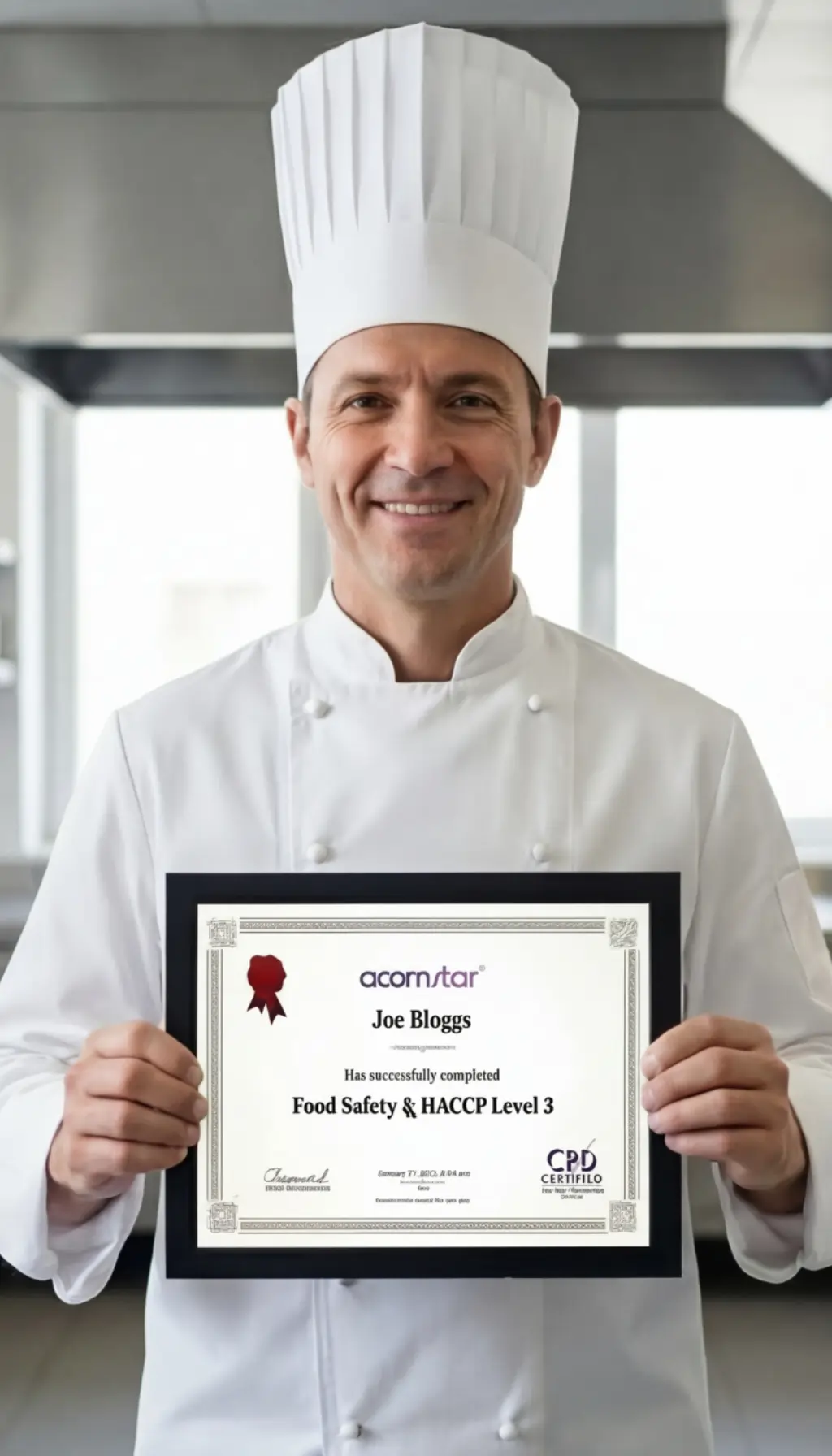
HACCP Level 1 should be the minimum for every food handler covering hygiene basics, temperature control, and contamination prevention. Supervisors benefit from HACCP Level 2, which goes deeper into food safety management. For owners and managers, HACCP Level 3 (Management HACCP) provides the comprehensive understanding needed to lead the programme effectively.
Allergen awareness training deserves particular attention given the seriousness of allergen incidents. Every team member needs to understand the risks, prevent cross-contact, and respond to customer questions accurately.
Online food safety courses delivered through a learning management system make certified training easier to roll out and refresh, so knowledge stays current across the team without disrupting service.
Take Action: Protect What You’ve Built
Your food business represents your investment, your reputation, and your future. Don’t leave its protection to a generic template that was never designed for your kitchen.
If you’re not sure your current HACCP folder is doing the job, find out. Book a quick review with a food safety professional who can assess your documentation, identify the gaps, and tell you honestly what genuine compliance would look like.
Enforcement is up. Inspections are tougher. Generic systems are increasingly likely to fail when it matters most. Don’t wait for an EHO visit to discover the folder you’ve been relying on isn’t actually protecting you.
Invest in a HACCP plan built specifically for your operation, by consultants who understand Irish food safety law. The cost is modest. The protection is comprehensive. The peace of mind is hard to put a price on.
Sleep easier knowing your food safety system is robust, compliant, and genuinely doing its job. Because in food safety, there’s no in-between only the right way and the risky way.
Elevate Your Business Standards
Operational excellence comes from two things working together: a well-trained team and robust safety systems. We provide both.
Train your team. Our accredited courses let your staff train at their own pace. For a limited time, Allergen Awareness training is included free with selected food safety modules.
- Kitchen essentials: from Level 1 Induction to Level 2 Food Handling and Level 3 Management.
- Comprehensive bundles: the Level 1 & 2 + Allergen Bundle covers the whole kitchen in one go.
- Site safety: protect your premises with Fire Warden and Slips, Trips & Falls courses.
Need deeper expertise? Our HSEQ Consultancy Services can help with risk assessments, safety statements, and full compliance auditing.
Smarter management for free. Business customers get exclusive access to our free Learning Management System. Manage all your compliance training in one place with a single smart login. Track enrolments, download certificates, and save your team serious time.
Get in touch today for corporate rates, or browse our full course list.